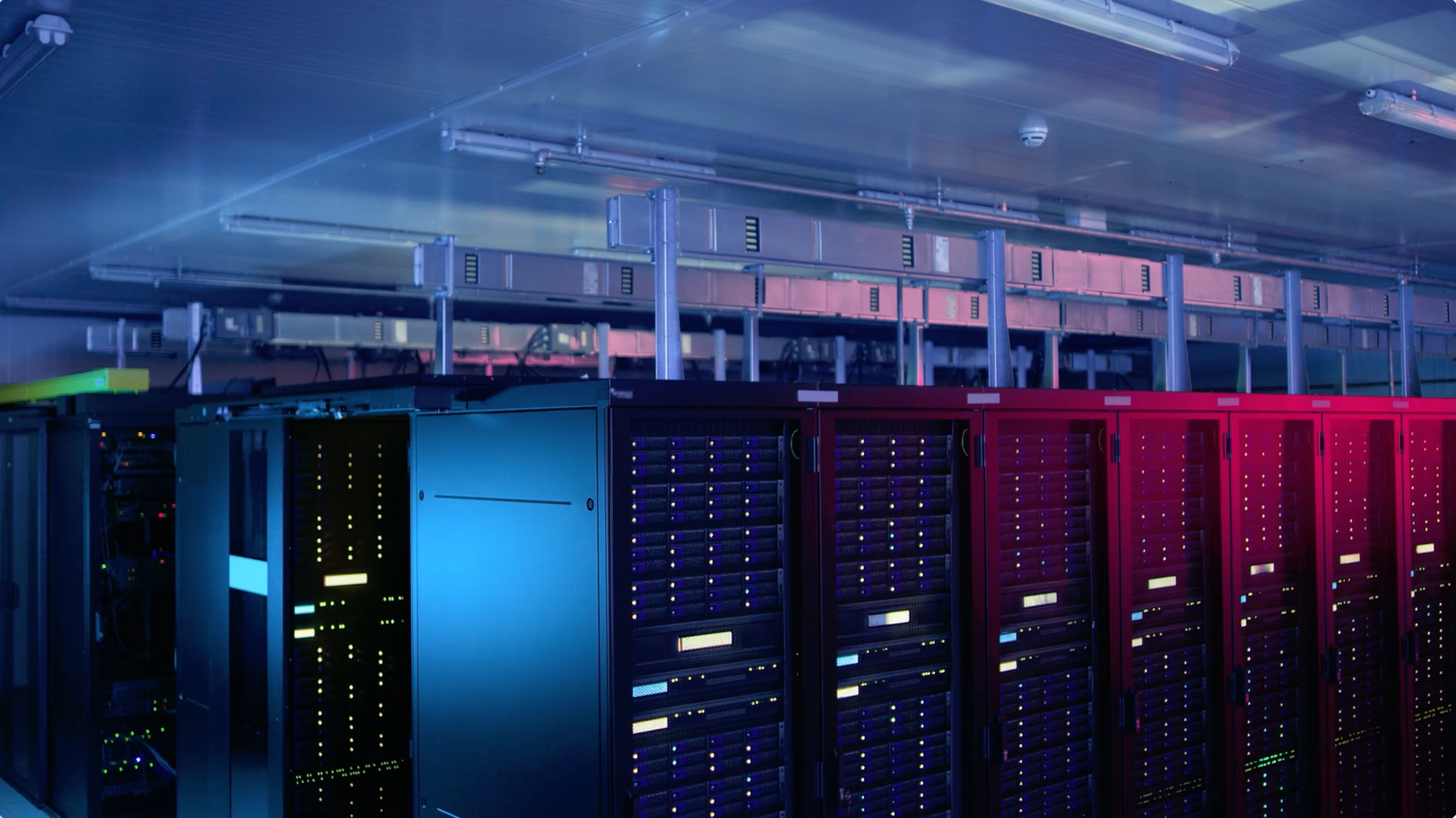
A data center is, electrically speaking, an unusual building. Its load is dense, close to constant around the clock, and almost entirely intolerant of interruption. Design choices that would be reasonable in an office or warehouse — a single utility feed, a modest generator, standard branch circuit density — stop being reasonable when a few seconds of lost power costs more than the equipment that failed.
Most of the cost and most of the risk in a data center build gets locked in early, during electrical design. Below is a walk through the decisions that matter most, and where projects tend to go sideways.
Redundancy: what the tiers actually mean
The Uptime Institute's tier classification is the common shorthand, and it's frequently misused. Tiers describe the topology of the infrastructure — how many independent paths exist and whether the facility can be maintained without shutting down — not a vendor's uptime promise.
- Tier I — a single path for power and cooling, no redundant components. Any maintenance means downtime.
- Tier II — single path, but redundant components (an extra UPS module, an extra generator). Better failure tolerance, still no concurrent maintainability.
- Tier III — multiple power paths with one active, redundant components, and every element can be taken out of service for maintenance without dropping the load. This is where most enterprise colocation lands.
- Tier IV — multiple active paths, fault tolerant, able to survive a single failure anywhere without any impact on the critical load.
The jump from Tier II to Tier III is the expensive one, because concurrent maintainability forces genuine duplication of distribution rather than just spare components. Deciding this after the electrical rooms are laid out is a costly change. Decide it first.
UPS topology and sizing
Uninterruptible power supplies bridge the seconds between a utility failure and generators reaching load. Three configurations dominate:
Double conversion (online)
Power is rectified to DC and inverted back to AC continuously, so the load is fully isolated from utility disturbances. The cleanest output and the standard for critical IT load. The tradeoff is conversion loss, though modern units have narrowed the gap considerably.
Line interactive
Regulates voltage without full conversion, switching to battery only on failure. More efficient, cheaper, and appropriate for less critical loads — network closets, building systems — but rarely for a primary white space.
Modular / scalable
Increasingly common. Rather than one large unit, capacity is built from hot-swappable modules. Capital cost tracks actual load, failed modules are replaced without dropping the system, and the facility grows in increments. The tradeoff is a higher cost per kW at full buildout.
On sizing: the most common mistake is designing to nameplate rating. Nameplate is what equipment could theoretically draw, and real load is usually far below it. Sizing to nameplate produces oversized gear running at poor efficiency, and oversized UPS systems are meaningfully less efficient at low load. Size to measured or realistically modeled load with defined headroom, then design the distribution so capacity can be added later.
Generators and transfer
UPS batteries buy minutes. Generators carry the facility through an actual outage, and the handoff between them is where designs are tested.
Key decisions:
- Start and transfer time. Battery runtime must comfortably exceed worst-case generator start plus transfer, including a failed first start attempt.
- Fuel on site. 24, 48, and 72 hours are common targets. Longer runtimes mean larger tanks, secondary containment, and often a different permitting path.
- Load bank testing. Generators that idle at light load for years develop wet stacking. Periodic testing at meaningful load is not optional.
- Transfer switch type. Closed transition briefly parallels generator and utility for a bumpless return, which usually requires utility coordination and approval. Open transition is simpler but interrupts.
Rack density and distribution
Rack power density has climbed steadily, and AI and high-performance computing workloads have accelerated it sharply. Racks that once drew 3–5 kW now routinely exceed 15 kW, and dense GPU deployments push far higher.
This changes distribution. Higher density favors busway over conduit-and-whip for flexibility, makes 415/240V distribution attractive for reducing conductor size and losses, and puts real pressure on cooling — which is itself electrical load.
A facility designed around 5 kW racks and built to last fifteen years will be obsolete long before the building is. Even if initial deployment is modest, oversizing the pathways — conduit, busway capacity, electrical room floor space — is far cheaper now than retrofitting later.
Cooling as electrical load
Cooling is frequently treated as a mechanical problem, but it lands squarely on the electrical system. In a conventional air-cooled facility, cooling can account for 30–40% of total consumption. That load needs its own redundancy: cooling that fails during an outage will force a thermal shutdown nearly as fast as a power failure would.
This is where PUE — Power Usage Effectiveness, the ratio of total facility power to IT power — comes from. A PUE of 2.0 means half your electricity runs the building rather than the computers. Well-designed modern facilities operate well below 1.5, and the gains come mostly from cooling strategy: containment, economizer hours, elevated supply temperatures, and increasingly liquid cooling for dense racks.
Utility coordination — start early
The single most underestimated item on a data center schedule is the utility interconnection. A large facility may require new substation capacity, transmission work, or upgrades with lead times measured in years rather than months. In constrained markets, available capacity has become a siting criterion in its own right.
Engage the utility before the site is finalized. Ask specifically about available capacity at the point of interconnection, upgrade lead time and cost allocation, redundant feed availability, and whether the site can participate in demand response or standby rate structures. Long-lead switchgear and transformers should be ordered as early as the design allows.
Grounding, bonding, and power quality
Grounding gets less attention than capacity and causes a disproportionate share of intermittent problems. Data centers combine dense electronics, high-frequency switching supplies, and long conductor runs — conditions that surface grounding weaknesses as noise, nuisance trips, and equipment faults that never quite reproduce on demand.
Worth designing deliberately: a proper signal reference structure, single-point bonding of separately derived systems, coordinated surge protection at service entrance and distribution, and harmonic analysis. Switching power supplies are non-linear loads, and harmonic currents can overload neutrals and derate transformers in ways a straightforward load calculation won't reveal.
Commissioning is the deliverable
A data center that has never been tested under failure is a set of assumptions. Commissioning turns it into a known quantity, and it should be scoped from the beginning rather than added at the end.
A thorough program works through factory testing of major equipment, component-level verification on site, functional testing of each system, and finally integrated systems testing — pulling the utility feed at full simulated load and confirming the entire chain responds as designed. That last stage is the one most often compressed under schedule pressure, and it is the only one that tests the design rather than the parts.
Document everything: sequences of operation, setpoints, single-line diagrams reflecting as-built conditions, and the test results themselves. The team operating the facility in five years will not be the team that built it.
This article is general industry information, not project-specific engineering advice. Codes, utility requirements, and permitting rules vary by jurisdiction and change over time — verify current requirements with your AHJ and a licensed engineer before acting on anything here. Questions about a project in California, Nevada, Arizona, or Utah? Get in touch with TRLINK.